
Strategists, there’s a hot new framework in town - it’s K-Shaped!
The growing gap between your richest and poorest customers demands sharper tools than demographic segmentation

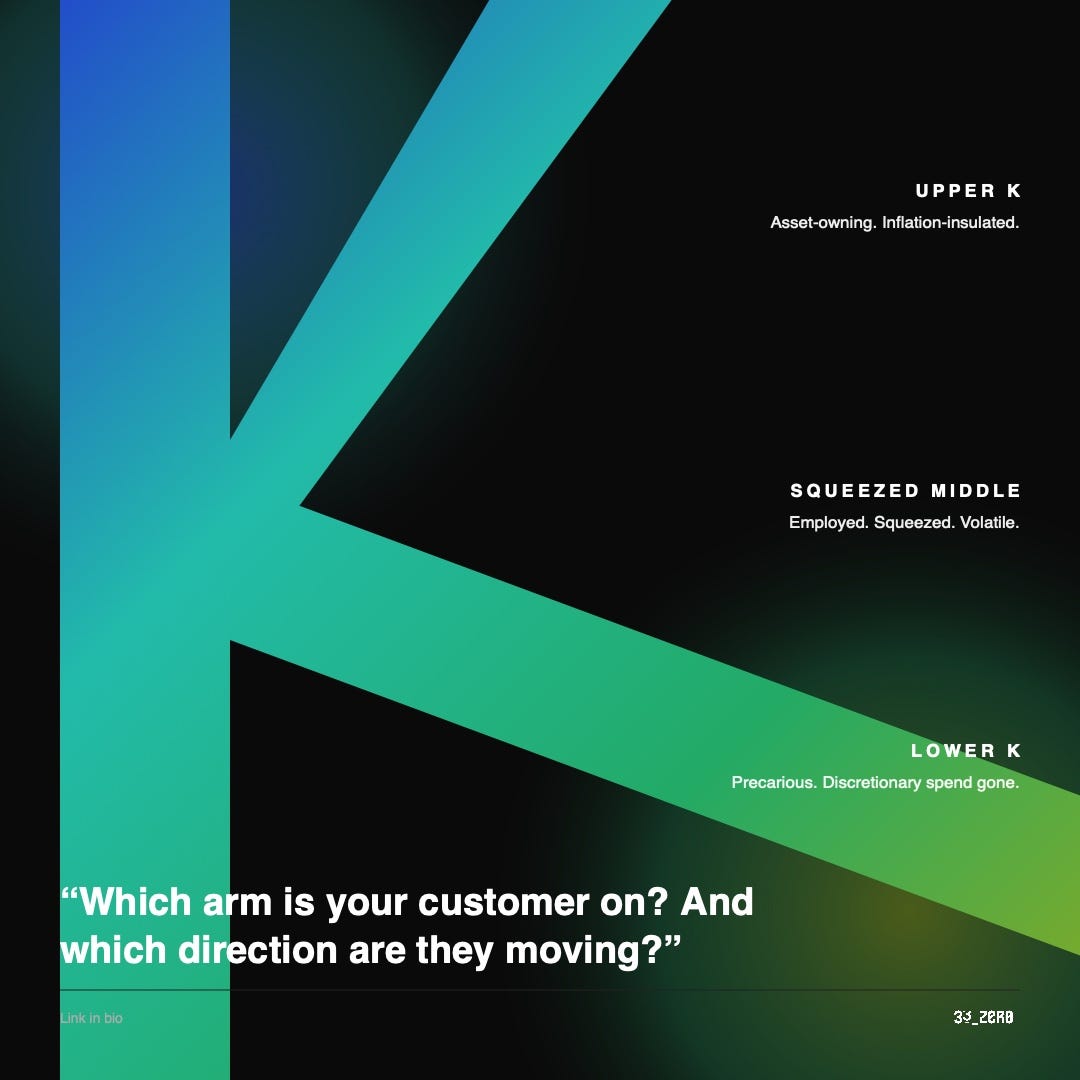
If 49% of all consumer spending in the United States is performed by the top 10% of households by wealth, is it possible that strategists who still think in terms of the old consumer segmentations - written on demographic tablets of stone hauled down from Mount Marketing - have one almighty blind spot?
The top 20% of US households by income (those earning $175,000 a year) account for 60% of US expenditure, according to the Fed’s distributional accounts.
In the UK, the ONS tells us the picture is not quite as extreme but still sufficient to determine our thinking on UK consumers, where the top 20% spend £948.70 weekly on average and the poorest fifth spend £378.60. Beyond the bittersweet takeaway that inequality is still not so extreme here, something else may be disguised that’s just as important to commercial strategy. That the UK’s richest 10% (holding 43% of all UK wealth) have a lower marginal propensity to spend on your brands. In simple terms, they invest more than they spend back into the economy.
Those of us confused by the mixed signals from markets - a runaway stocks boom attended by rising fuel costs and employment paralysis - have to look to the K-shaped economy to make sense of a dynamic that doesn’t fit traditional models.
On paper, the US economy is holding up. In reality, it’s bifurcating. Data centre investment accounted for 92% of GDP growth in the first half of 2025, according to Harvard economist Jason Furman. Absent that single wave of hyperscaler spending, growth would be barely above zero.
The returns on all that AI investment aren’t circulating broadly - they’re pooling in asset portfolios, compounding a dynamic that began with post-2008 quantitative easing; money creation always hits a particular point in the economy first, usually fuelling asset inflation. 2025 was the weakest year for US job creation outside of recession since 2009, with just 584,000 jobs added. MacDonald’s - whose traffic numbers function as a real-time confidence gauge for the squeezed middle - only recovered volume in 2025 by leaning hard into value promotions. The last time they went on promotion in response to declining sales was 2020 - Covid.
Just as the economics demands new ways of thinking, so does the consumer reality that flows from them. The K is not just an economic description - it’s the condition in which brands operate, culture is formed and strategy must make its recommendations. An asset-rich, inflation-insulated consumer does not experience the same category, respond to the same proposition or occupy the same cultural moment as one rationing discretionary spend.
The present moment is crying out for a model that sits across dumb demographic segmentation - and yet the dominant response from strategy is still to retreat to generational archetypes. Xs, Ys and Zs. “Over-45s are younger at heart than ever and hold seven times more disposable income.” As usual, this stuff is more revealing of the person writing it than of their subject.
Generational segmentation was always a simplification; in a K-shaped economy it becomes a category error. The over-45 whose portfolio has compounded nicely since 2008 and the over-45 on a zero-hours contract are not the same audience, however neatly they share a birth decade.
Applying the K
Let’s see if the K can be applied as a useful new lens on audiences, brands and culture. I don’t want to offer this model as in any way definitive. In fact, that’s the point. This is a model like the K, that indicates direction and movement. Not a static segmentation.
For the purpose of the illustration, I genuinely picked three brands at random based on them sharing the same first letter and being sufficiently diverse from each other across categories. So, we have Microsoft, MacDonald’s and Macmillan.
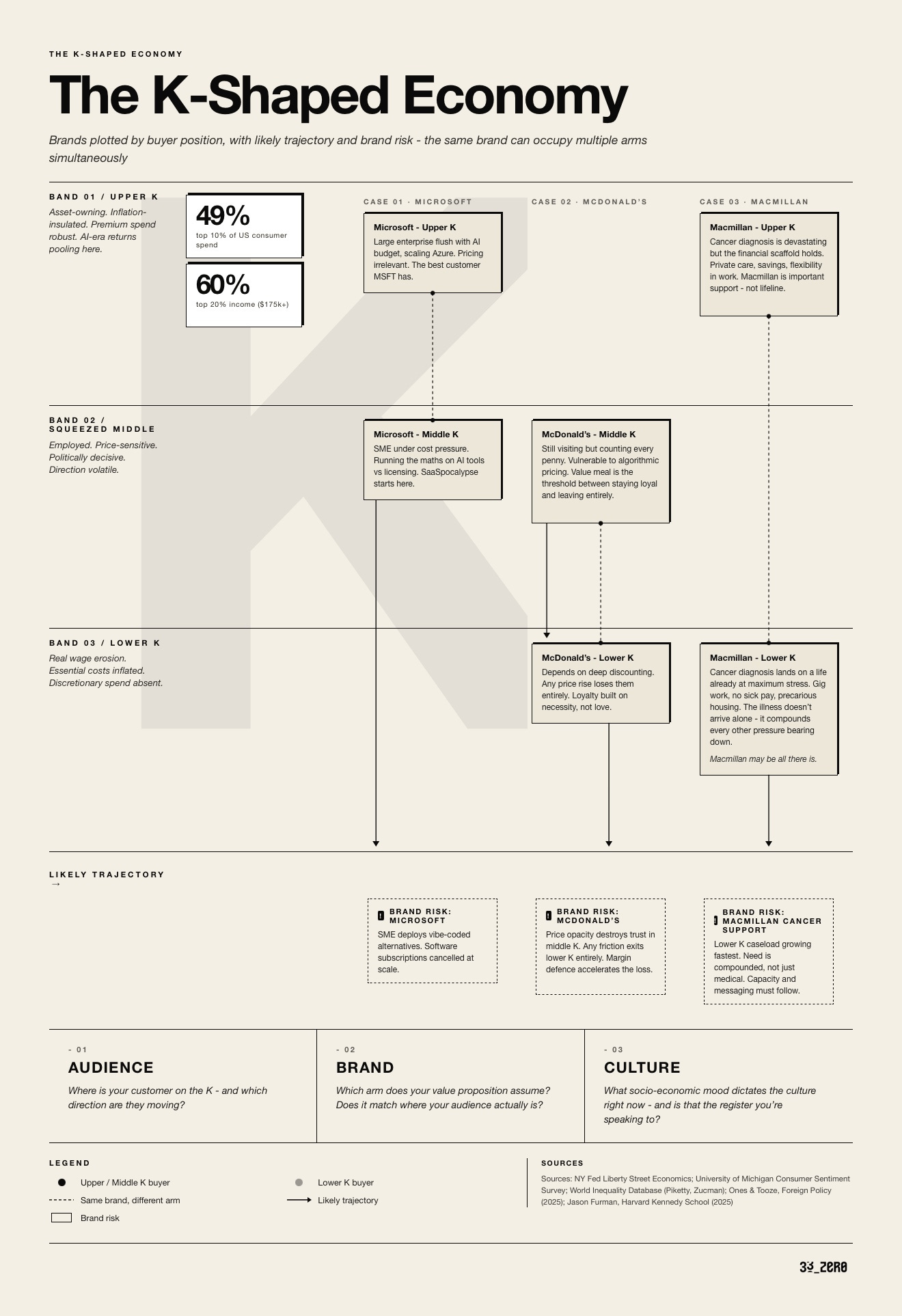
Like any model there are brutal generalisations. While the Microsoft buyer is usually a committee whose members are, admittedly, participants in the consumer economy this model is most valuable to our thinking about B2C. A business customer isn’t so usefully plotted on the K. But it works and B2B does consider its customer personas in lived context. For many SMEs who are Microsoft customers, their subscription decisions will be affected by feedback loops from the consumer economy that overlap managers’ own experiences of the economy.
Macmillan are already ahead of this. Their entire structure - nurses in daily interaction with their audience - provides the kind of qualitative insight that has made inequality core to their current strategy. Chief Executive Gemma Peters has said that “cancer can be even worse for some, simply because of who they are or where they live” - leading their current strategic focus on reducing health inequities, addressing variation in cancer treatment and care and targeting marginalised communities where the compound effect of illness and material precarity is most acute. This is a brand that operates where rubber hits the road at all times. Their response is to shift their proposition, developing social investment models at neighbourhood level to fill a gap they know the NHS alone can’t meet.
Brands that lack Macmillan’s daily interface with the lived reality of their audience won’t be so quick to respond. The K is a description of the world your customers are actually living in. Getting this wrong doesn’t just affect campaign performance - it affects whether brands remain relevant to the people they need to reach.
Because it is a way of segmenting audience that is informed by economic trajectory, what the model may be most useful for is identifying risks or opportunities that lay ahead as consumers move either up or down on the the K. So, a small business owner under cost pressure at work and at home may redouble their efforts to put in nights working through Claude Cowork automations that cut down their dependency on software licences. Thus exposing Microsoft to declining renewals. Just as the ‘squeezed middle’ MacDonald’s visitor might jettison the MacDonald’s app if they sense they’re not seeing the right deals, due to algorithmic digital pricing.
The K-shaped economy might be a recent buzz term but the structural forces driving it date back to 2008 - to the excess money creation that has propped up markets through several rounds of exogenous shock, inflated asset values and delivered us to a point where the blunt instrument of central bank rate-setting is applied regardless of the pain it inflicts on the majority of consumers. That dynamic isn’t reversing. Unless you can see a different economy coming into view, the robustness of your value proposition needs testing against a consumer backdrop that maintains this trajectory indefinitely.
The next time someone puts a generational segmentation in front of you, ask one question: which arm of the K are these people on, and which direction are they moving? If they can’t answer it, it’s not a segmentation - it’s a panacea for the messiness of reality. The wrong tool for the job.
About 33_Zero
33_Zero works with brands large (AWS, Oxfam) and small (Agronomics, Ivy Farm) on brand and comms. Our clients recognise that unprecedented change needn’t be a threat but an opportunity. We help your brand show up and participate in this new reality.
Email jamesp@33seconds.co or subscribe and DM us here to find out more.